
The journey down the environmental path
//
Afia Salam
The history of environmental development has been gradual, however, with climate change impacts accelerating towards increasing adaptation and protection of its ecosystems and environment.
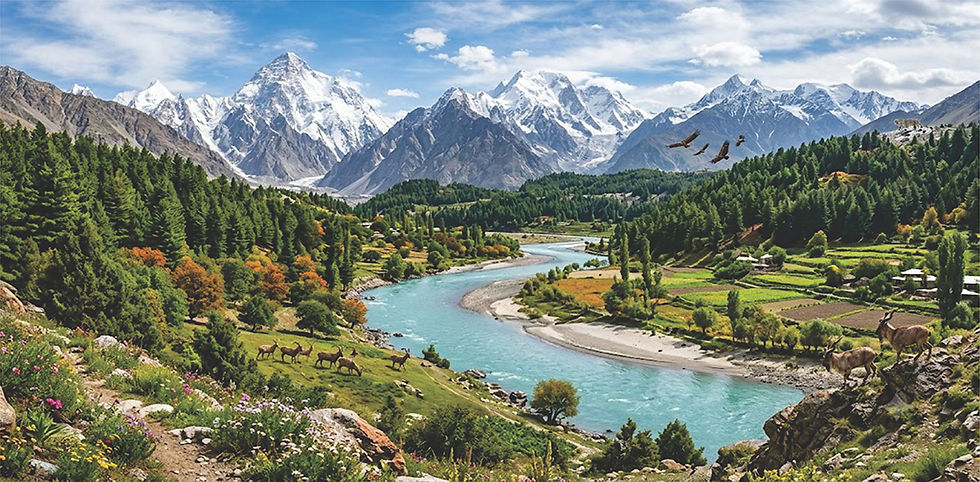
For a geographically diverse country like Pakistan, hosting more than 10 major and minor eco and agroecological zones, one would expect that environmental matters would take center stage. However, Geography is not the sole determinant of the priority list especially for a country that had had a cataclysmic birth, and was in survival mode for most of its first decade, and then again facing cataclysmic dismemberment of the Eastern wing that did face the brunt of Nature’s wrath through cyclones and floods that caused widespread devastation.
After the dismemberment of the country, which set Pakistan back many years, the recovery and development imperatives pivoted to sectors other than environmental conservation and stewardship. Globally there was a greater awareness emerging post the Stockholm United Nations Conference on the Human Environment, by the time the Rio Earth Summit took place in 1991, conservation, development and governance came together.

By 1993, Pakistan had compiled its NEQS, National Environmental Quality Standards that became the handbook for the Environment Protection Agency, the regulatory body. In sync with the global environmental movement, there was a resonance within Pakistan’s civil society, which went beyond activism and stewardship, and opened the door of environmental jurisprudence after the landmark Shahla Zia v WAPDA case in 1994 that firmly placed environmental litigation under the Right to Life.
Several things came together at the turn of the millennia, and the pace quickened world over once the reality of Climate Change and its impacts snatched the limelight from many other issues that had been capturing the headlines. Pakistan too was raising its profile regionally and globally, as an active participant, not always for good reasons.
The climate vulnerability index was in place and out of over 190 countries, Pakistan found itself in the top ten bracket almost from the outset. While this meant bearing the brunt of climate disasters, it also allowed it to grab a seat at the table where conversations about combating climate change were taking place. This was happening alongside the rise in the consciousness and acknowledgement of the importance of focus on environment in society, as well in the governance hierarchy.
Governance structure changes within the country also brought greater focus. In 2010, the landmark devolution law, known as the 18th Amendment was passed which devolved many subjects, including Environment, Climate Change, Forestry, Wildlife etc were all devolved to the provinces.
There was a period of ambivalence which was very anachronistic given the growing importance of this sector. Before the 18th. Amendment, the Federal Ministry of Environment looked after all matters related to environment and climate change. After the 18th Amendment, initially, the federal ministry was abolished, and it was renamed as the Ministry of National Disaster Management in April 2012.
Establishment of Ministry of Climate Change (2012):
Recognising the global climate crisis, in 2012, Ministry of National Disaster Management was renamed the Ministry of Climate Change (MoCC), and for a period, in 2013, the ministry was demoted to a Division under the Cabinet Secretariat to cut costs.
It was later again restored as a full-fledged ministry and officially established in its current form in 2017.
By this time the provincial ministries had been strengthened and had drafted their province specific policies, reducing the on ground interventions by the Federal Ministry which now functioned as a policy body and custodian of Pakistan’s bilateral and multilateral treaties, agreements, conventions and MoUs.
Because of this specific role, the nomenclature again changed and in 2022, its name received an appendage and now it functions as the Ministry of Climate Change and Environmental Coordination.
This allows for a better coordination with the provincial ministries as well as with international partners.
The new name brought a new focus on the roles and responsibilities. It allows it to function as a convening body that can have an oversight on provincial aspirations that align with the broader national agenda, while freeing it from the responsibilities of on ground implementation. This also allows for greater leverage on the regional and global platforms to be able to play a more influencing role.
This has made Pakistan a strident voice at forums like the COPs and UNEP which have acknowledged Pakistan’s leadership role closure of hitherto inconclusive conversations like Loss and Damage and the imperative of bringing in a just solution to countries in the Global South
This has also allowed the Ministry of Climate Change and Environmental Coordination to gain some quick wins by way of bilateral and multilateral forums to bridge the policy and implementation gaps by accessing technical and financial assistance through readiness grants to build capacities and fill policy grants. One example of this is the preparation of the ccGAP (Climate Change Gender Action Programme), which has paved the way for mainstreaming women in six priority sectors. (Courtesy: The News PK)
The writer is an environment and climate change journalist, member of National Climate Change Council and member of National Coordinating body for Marine Protected Areas


Comments