
Inferno on M.A. Jinnah Road: The Anatomy of the Gul Plaza Tragedy

//
Aleem Chaudhary
On the night of January 17, 2026, the skyline of Karachi was stained by a column of black smoke so dense it blotted out the lights of the M.A. Jinnah Road corridor. Gul Plaza, a sprawling commercial fortress that had stood for decades as a nodal point of Pakistan’s wholesale trade, was burning.
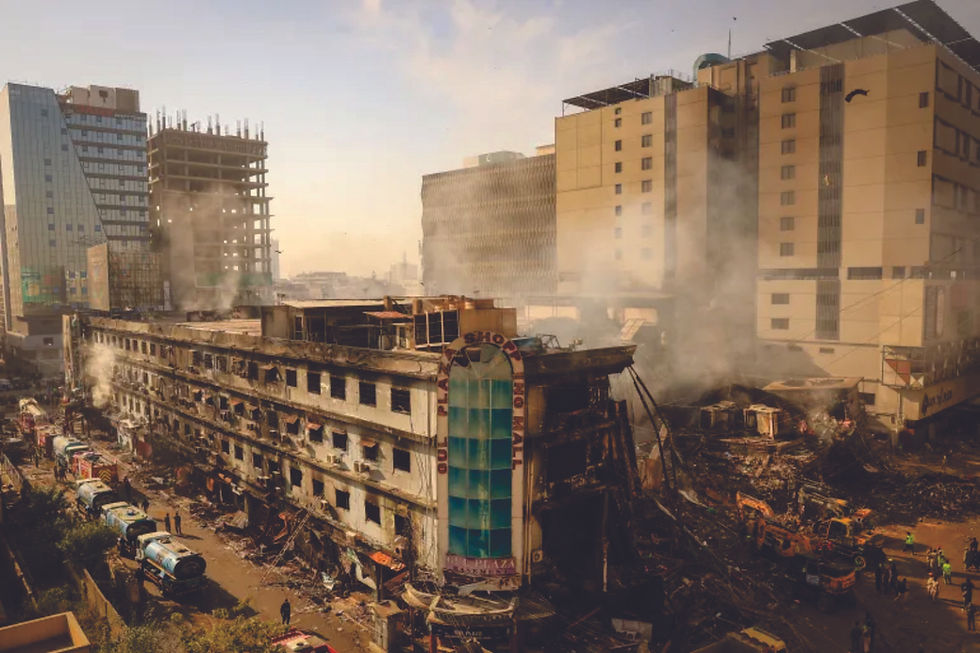
What began as a flicker in a shop selling artificial flowers metastasized into a catastrophe that has permanently scarred the city’s consciousness. By the time the cooling process concluded nearly four days later, the statistics were grim: 79 dead, over 1,200 shops incinerated, and an economic ecosystem worth billions reduced to ash.
However, to view the Gul Plaza fire merely as an accident is to misunderstand the mechanics of urban disaster in Karachi. Interviews with survivors, analysis of emergency logs, and discussions with urban planners reveal that this was a tragedy foretold, a collision of regulatory negligence, infrastructural collapse, and the legal precariousness of Karachi’s informal economy.
Part I: The Night of January 17
The timeline of the disaster, reconstructed from CCTV footage recovered from adjacent buildings and eyewitness testimony, paints a picture of terrifying speed.
At 10:15 PM PST, a fire broke out in Shop No. 193 on the first floor. The shop specialized in imported synthetic flowers and gift items, products made of polyester and plastic, materials that do not just burn; they melt and flow, carrying fire across surfaces like liquid. According to the preliminary inquiry report submitted by the Sindh Police, the ignition source was tragically banal: a burning matchstick dropped carelessly. In a building compliant with modern safety codes, a single match would trigger a sprinkler system or be contained by fire-resistant drywall. In Gul Plaza, it met a perfect storm of flammability.
“The shop was packed floor-to-ceiling with cardboard and plastic,” recounted Asif Memon, a security guard who was among the first to spot the smoke. “Within three minutes, the heat was so intense that the glass front of the shop opposite it exploded. It was not a fire; it was a blast of heat.”
Structural engineers point to the building's architecture as a primary accelerant. Gul Plaza, like many commercial centres constructed in the rush of Karachi’s expansion, featured a central atrium and narrow, vertical air ducts. Dr. Noman Ahmed, an urban planner and architect, explains the phenomenon that doomed the victims: “The building acted as a chimney. Once the heat reached a critical threshold, the central ducts sucked the superheated toxic gases upward. The fire did not just spread room by room; it raced up the ventilation shafts, trapping people on the upper floors before they even realized the ground floor was alight.” By 10:45 PM, just 30 minutes after ignition, the blaze was classified as a Grade-3 fire, the highest category of urban conflagration.
Part II: The response and the water crisis – A city without hydrants
The response to the Gul Plaza fire exposed the most critical failing of Karachi’s emergency infrastructure: the absence of a functional water hydrant network. The first fire tenders from the Karachi Metropolitan Corporation (KMC) arrived at 10:48 PM, a respectable response time given the traffic chaos. However, the tragedy lay not in their arrival, but in their capacity. A standard fire tender carries approximately 1,000 to 2,000 gallons of water, enough for perhaps five to seven minutes of high-pressure firefighting.
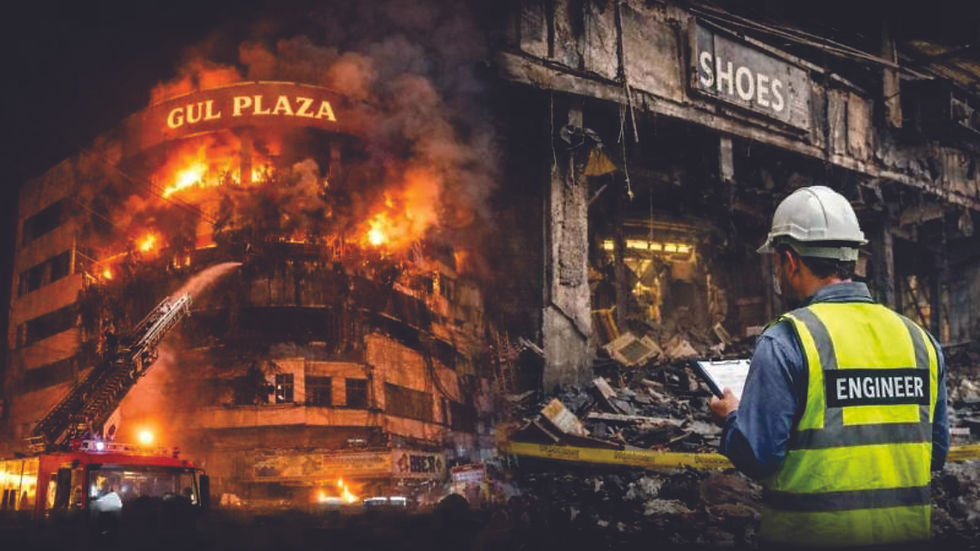
“We emptied our tanks in minutes,” stated a senior station officer from the Central Fire Station, speaking on condition of anonymity. “When we looked for hydrants, there were none. The nearest functioning filling point was kilometres away at the NIPA or Sakhi Hassan hydrants. We had to leave the burning building to fetch water.”
This “shuttle system,” where fire engines leave the scene to refill, broke the momentum of the rescue operation. During the 40-minute round trips made by tenders to refill, the fire, which had been momentarily suppressed, regenerated with ferocity.
While the KMC, Rescue 1122, and Pakistan Navy fire units eventually arrived, coordination was chaotic. The narrow lanes surrounding Gul Plaza were clogged with illegal parking and encroaching stalls, preventing the heavy snorkel trucks from getting close enough to rescue victims trapped on the 4th and 5th floors.
Footage from the night shows rescuers resorting to desperate measures, using sledgehammers to break through concrete walls from neighboring buildings to create escape tunnels. It was in one such attempt that Furqan Ali, a 36-year-old firefighter, lost his life when a heat-weakened beam collapsed. His death underscores the lack of structural integrity assessments available to first responders in real time.
Part III: The toxic aftermath – The environmental fallout
The Gul Plaza fire did not just burn; it poisoned. The inventory inside the mall, thousands of tons of melamine crockery, synthetic rugs, aerosol cans, and PVC toys, created a chemical cocktail when ignited.
For 48 hours following the blaze, a thick, black plume loomed over Saddar, Ranchore Line, and Kharadar. The Sindh Environmental Protection Agency (SEPA) reported that the Air Quality Index (AQI) in the vicinity spiked to 450, a level considered “hazardous” to human life.
“The smoke contained high levels of dioxins and furans,” warned Dr. Seemi Jamali, a leading emergency medicine specialist. “Residents living downwind of M.A. Jinnah Road inhaled micro-particles of burnt plastic. We saw a surge in acute asthma attacks and respiratory distress at JPMC in the days following the fire. The long-term carcinogenic effects on the firefighters and residents are a silent ticking bomb.”
Part IV: The economic catastrophe – Billions in ash
While the loss of life is the primary tragedy, the economic annihilation caused by the Gul Plaza fire is a crisis of national proportions. The plaza was not merely a retail mall; it was a wholesale redistribution centre for the entire country. Goods imported into Karachi were stored here before being shipped to markets in Lahore, Rawalpindi, and Peshawar.
Preliminary estimates by the Karachi Chamber of Commerce and Industry (KCCI) suggest the inventory loss alone exceeds Rs. 45 billion. However, the true cost is far higher.
The most heart-wrenching economic aspect of this tragedy revolves around the Pugree system, a traditional, semi-formal tenancy arrangement common in Karachi’s older markets.
Under the Pugree system, a trader pays a massive upfront sum (often tens of millions of rupees) to the building owner for the “goodwill” or “possession” of the shop. They own the business rights and pay a nominal rent, but they do not hold the title to the land or the structure.
“I paid 25 million rupees for the Pugree of my crockery shop three years ago,” said Kashif Bhai, a trader whose shop is now a pile of rubble. “I do not own the land. Now that the building is destroyed, the landlord says the structure is gone, so my tenancy is over. The insurance companies say they do not cover Pugree rights, only stock, and most of us did not have stock insurance because premiums were too high for an ‘unsafe’ building.”
This legal grey area means that hundreds of families have not just lost their income; they have lost their entire accumulated wealth. If the building is demolished, as engineering reports suggest it must be, the Pugree holders may walk away with nothing, sparking fears of a wave of bankruptcies and suicides among the trader community.
Part V: The human toll and forensic challenges – The agony of identification
The intensity of the heat, which reportedly exceeded 800°C in the core of the building, created a forensic nightmare. Many of the 79 victims were burned beyond recognition. For families, the tragedy was prolonged by the agonizing wait for DNA confirmation. Outside the mortuary at Civil Hospital, scenes of almost biblical grief played out for weeks.
“They asked me for my brother’s toothbrush or hairbrush for DNA matching,” said Rizwan, whose younger brother worked in a toy warehouse on the third floor. “We waited 14 days just to get a body bag. We could not even see his face. We buried a sealed coffin.”
The cooling process of the building took nearly 72 hours, preventing rescue dogs and teams from entering the deeper recesses of the structure. This delay meant that for three days, families stood outside the smoking ruins, knowing their loved ones were inside but unreachable, a psychological trauma that no compensation cheque can heal.
Part VI: Institutional failure – The paper trail of neglect
The Gul Plaza fire was not an accident; it was a systemic production. Investigative reporters have unearthed a history of ignored warnings. According to documents leaked from the Sindh Building Control Authority (SBCA), Gul Plaza had been issued multiple notices over the last decade regarding:
Illegal expansion: shops constructed in the parking lot and emergency corridors.
Lack of fire safety: the absence of a functioning sprinkler system or pressurised fire hydrants within the building.
Electrical load: the building’s wiring was designed for the 1990s, yet it supported thousands of air conditioners and heavy industrial lights, creating a perpetual short-circuit hazard.
Despite these notices, the plaza was never sealed. “In Karachi, everything can be ‘regularised’ for a fee,” alleges a former KMC official. “The building inspectors would come, issue a notice, take a bribe, and leave. The traders were also complicit; they refused to pay for maintenance or clear the corridors because every inch of space was used to store stock.”
The tragedy has exposed the utter toothlessness of the Civil Defence Department, which is legally mandated to conduct fire safety audits but lacks the staff, vehicles, and authority to enforce compliance.
Part VII: A call for urban reform — Beyond compensation
The Sindh Government’s announcement of Rs. 10 million compensation for the deceased and the formation of a judicial inquiry is a standard post-disaster script. However, the stakeholders of Karachi demand more than performative governance.
The Gul Plaza tragedy necessitates a radical overhaul of Karachi’s urban management:
Decoupling water for firefighting: Karachi cannot rely on domestic water lines for emergencies. A dedicated, high-pressure saltwater hydrant system, pumping directly from the Arabian Sea, must be established for the commercial corridors of Saddar and M.A. Jinnah Road.
Legal protection for Pugree holders: The provincial assembly must pass emergency legislation to protect the equity of Pugree holders in the event of structural disasters, ensuring they retain rights to the space in any reconstructed building.
The “safety audit” mandate: Immediate, third-party safety audits for all high-rise commercial markets (including Zainab Market and Bolton Market). Buildings failing these audits must be retrofitted immediately, not just fined.
Criminal liability: Negligence must be criminalised. Building owners and government inspectors who sign off on unsafe structures must face manslaughter charges, not just administrative transfers.
In conclusion, As the excavators finally begin to clear the mountain of debris that was once Gul Plaza, they are removing the physical evidence of the tragedy. But the invisible scars remain. The fire on M.A. Jinnah Road did more than destroy a building; it illuminated the fragility of life in a megacity run on ad hoc arrangements. It exposed how a missing hydrant, a bribed inspector, and a locked exit door can conspire to kill. For the 79 souls lost, and the thousands whose livelihoods have evaporated, the only meaningful memorial is a city that refuses to let this happen again. Until Karachi values human life more than the cost of a sprinkler system, the next fire is not a possibility; it is an inevitability.


Comments